
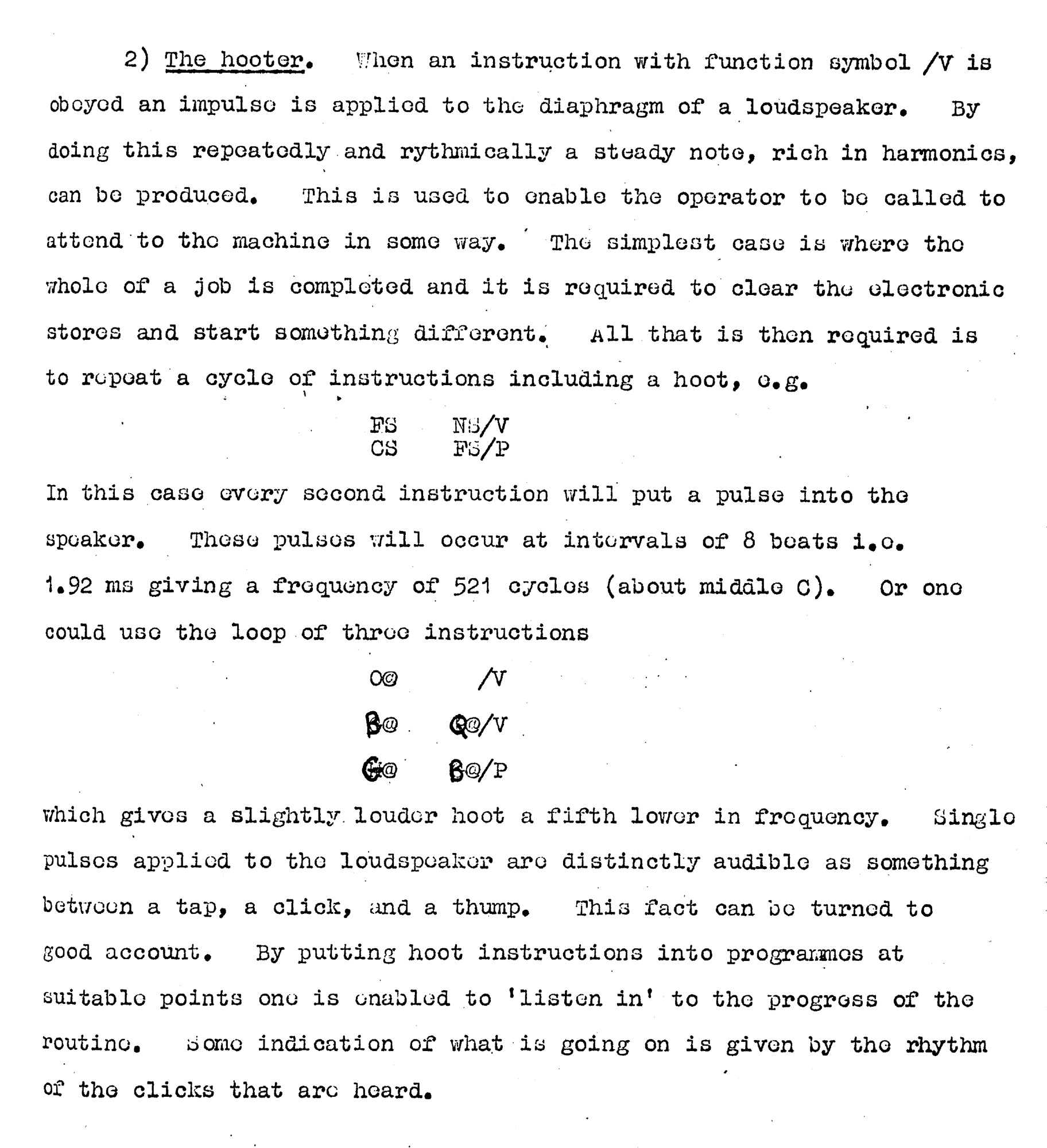
Alan Turing, Programming instructions for the Manchester Mark II, 1950, Computer History Museum, Donald E. Knuth papers, 102724592 [Public Domain].
ABOUT CODE
In 1950, computers were massive screenless machines filling entire rooms, and programmers needed ways to monitor whether their programs were running correctly. Alan Turing, working on the Manchester Electronic Computer Mark II, documented an innovative solution in his Programmers’ Handbook: an audio signal called “the hooter” that allowed programmers to listen in to the progress of their programs.
Turing described this sound using the language of music theory – “a steady note, rich in harmonics”, “about middle C”, and “a fifth lower in frequency”. By pairing technical descriptions with musical terms of notes, pitches, and intervals, Turing established a connection between computer programming and musical thinking. Musical sound delineated the “form” of the program, marking moments in its ongoing process and making the computer’s invisible operations perceptible through familiar auditory patterns.
This approach to using musical sound has become naturalized in our interactions with computers today. Though we may not use sound for debugging in contemporary programming environments, startup chimes and error bloops still offer us a mode of relating to computer processes through musical gesture, particularly when we cannot peer under the hood and monitor processes ourselves. Musical sound gives voice to the program, making its liveness audible as an ongoing process, for both Turing in 1950 and for us in 2025.
BIOGRAPHY
Kate Mancey is Assistant Professor of Music and Media at Utrecht University. Her research focuses on intersections of music, technology, and society, across various periods and genres. She is especially interested in relationships between (vernacular) philosophies of music and of technology, and the role of music and sound in human-technology relationships.
#Early Programming
#Music

