
the famous World3 model by MIT.
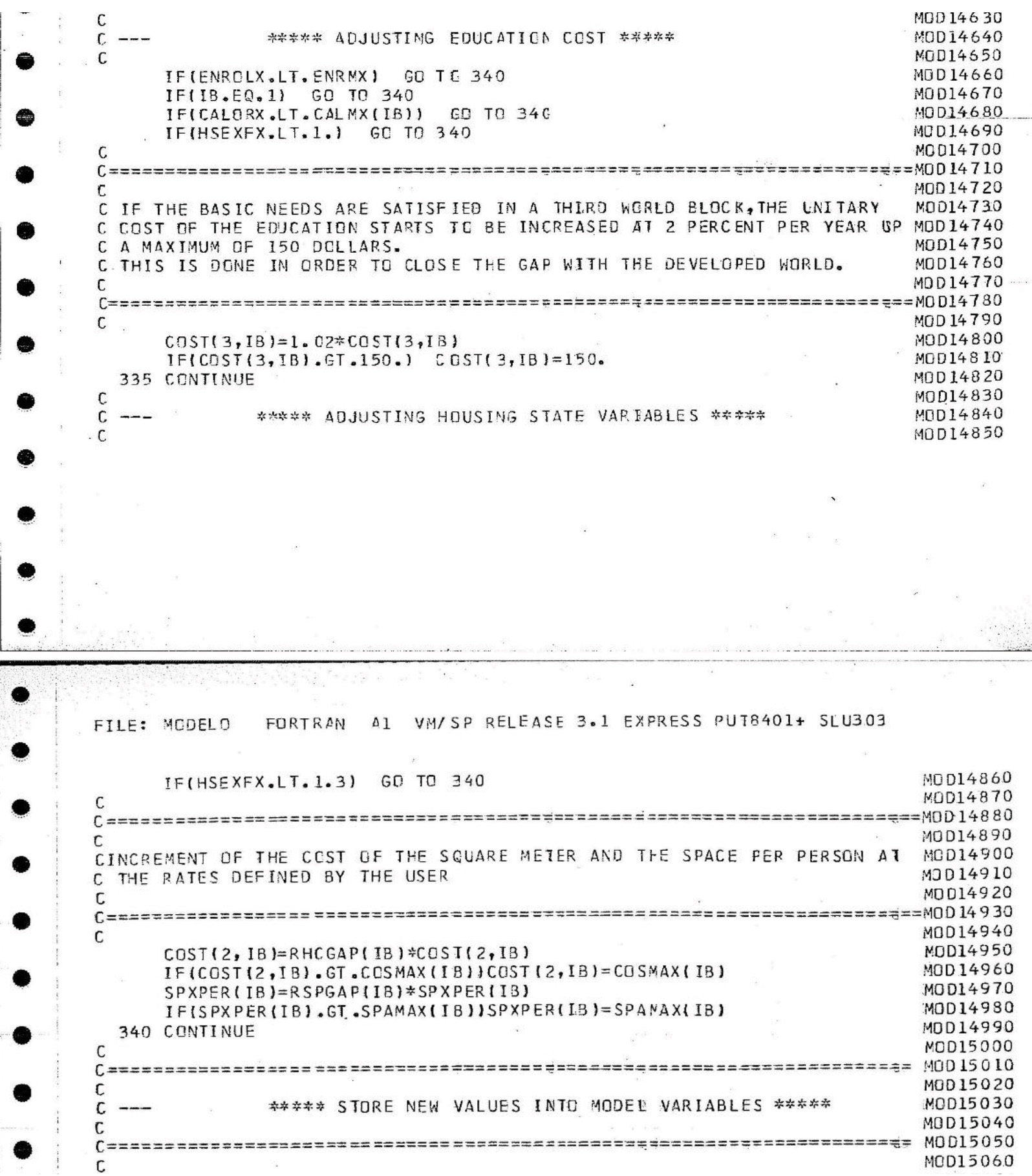
H. Scolnik, L. Talavera, I. Loiseau, M. Camuyrang, J. Perrez Iturrioz, E. Rocchi, C. Ruiz, Printed code sheet, 1976 [© Hugo Scolnik].
ABOUT CODE
Even in the early years of computer science, the idea that the world could be understood as a system that could be simulated by computers was already popular. Early digital simulations promised to understand and predict global trends acting as warning devices without offering ways to avoid their predicted futures.
The LAWM (Latin America World Model), developed by a multidisciplinary team around Argentinian geologist Amílcar Herrera, deliberately tried to steer an early global community of world modelers toward solutions, not risks. With a focus on basic needs – like adequate housing, education or protein intake – the model indicated a path towards optimal allocation of labor and capital to ensure the longest possible life expectancy. Their model showed that a global catastrophe was not imminent; with the use of optimization and planning, there were even ways for the less wealthy regions of the world to reach a standard of living as in the US or European countries.
The code is of double interest: it exemplifies both the grammar and lexicon of one of the earliest and most widely used high-level programming languages, Fortran, and the way computer programs are never neutral, but instead embody particular political visions.
BIOGRAPHY
Fenwick McKelvey is an Associate Professor in Information and Communication Technology Policy in the Department of Communication Studies at Concordia University. He leads “Machine Agencies” at the Milieux Institute. He studies digital politics and policy.
Markus E. Ramsauer is a PhD Candidate in the History of Science at the University of Vienna. Ramsauer investigates origins of global simulation models in relation to the Global South.
#Simulation
#Politics

