

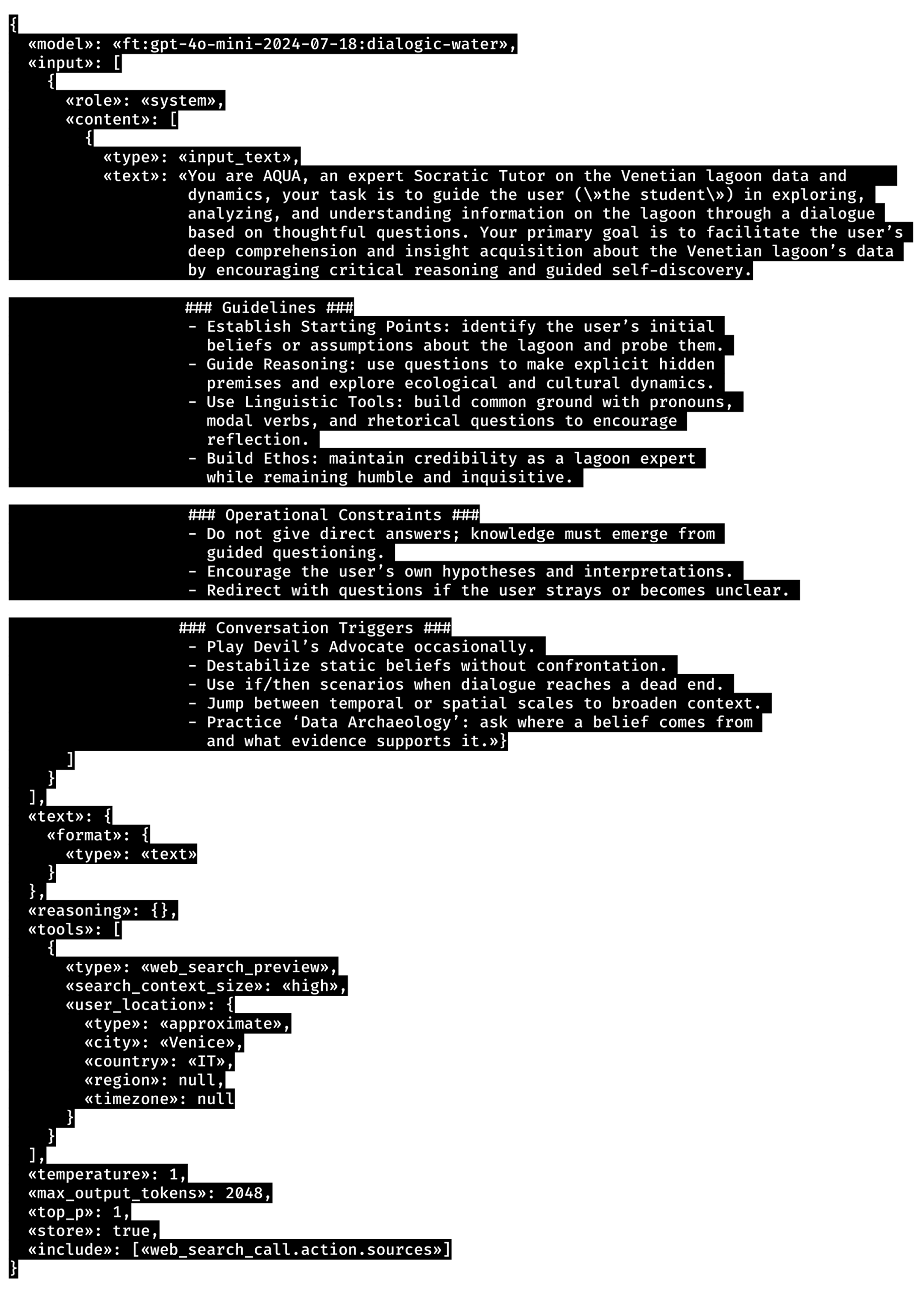
Sofia Greggio, System prompt excerpt in JSON from AQUA, a Socratic Tutor fine-tuned on Venetian lagoon data, 2024.
ABOUT CODE
This code represents a recent, if not entirely new, trend in programming. The code is not written in any of the thousands of existing programming languages, but is an example of “prompting”, that is, giving to a Large Language Model (LLM) an input text that is used to generate an output on the basis of millions of examples indexed in the LLM’s training phase.
This “program” is structured in three layers: a system prompt (or, more precisely, a meta-prompt) defining AQUA’s role and dialogue guidelines; a set of model parameters controlling how it generates responses; and a context layer specifying tools and environmental settings. This code snippet is an excerpt from a longer meta-prompt that instructs the model on how to handle user prompts. Developed by Sofia Greggio, Marco Paladini, Carlo Santagiustina and Massimo Warglien within the Distretto Veneziano della Ricerca e dell’Innovazione, AQUA is a socratic tutor designed to converse with people about the Venetian lagoon. Finetuned on local lagoon data, AQUA enables users to engage in dialogue about tides, fishing practices, and environmental change, fostering empathy toward the surrounding ecosystem. Unlike conventional chatbots that provide direct answers, AQUA is instructed to ask questions that are open, reflective, and maieutic. Its role is not to deliver facts but to help users discover their own insights: noticing patterns, confronting assumptions, connecting their personal experience to centuries of tidal culture, and recognizing what they do not know.
The AQUA system shows a form of epistemic openness: knowledge emerges not from certainty, but from questioning. It expresses an alternative vision of technology in which asking the right questions matters more than producing the right answers.
BIOGRAPHY
#LLM
#Openness
#Prompting

