
Nanako Shiraishi, Code and commit message, committed on Saturday, June 20th, 2009 at 14:37:09 (UTC+09:00) [GNU General Public License v2].
ABOUT CODE
This small script adds a new functionality (the stash command) to the Git environment, which is probably the most used collaborative version control system.
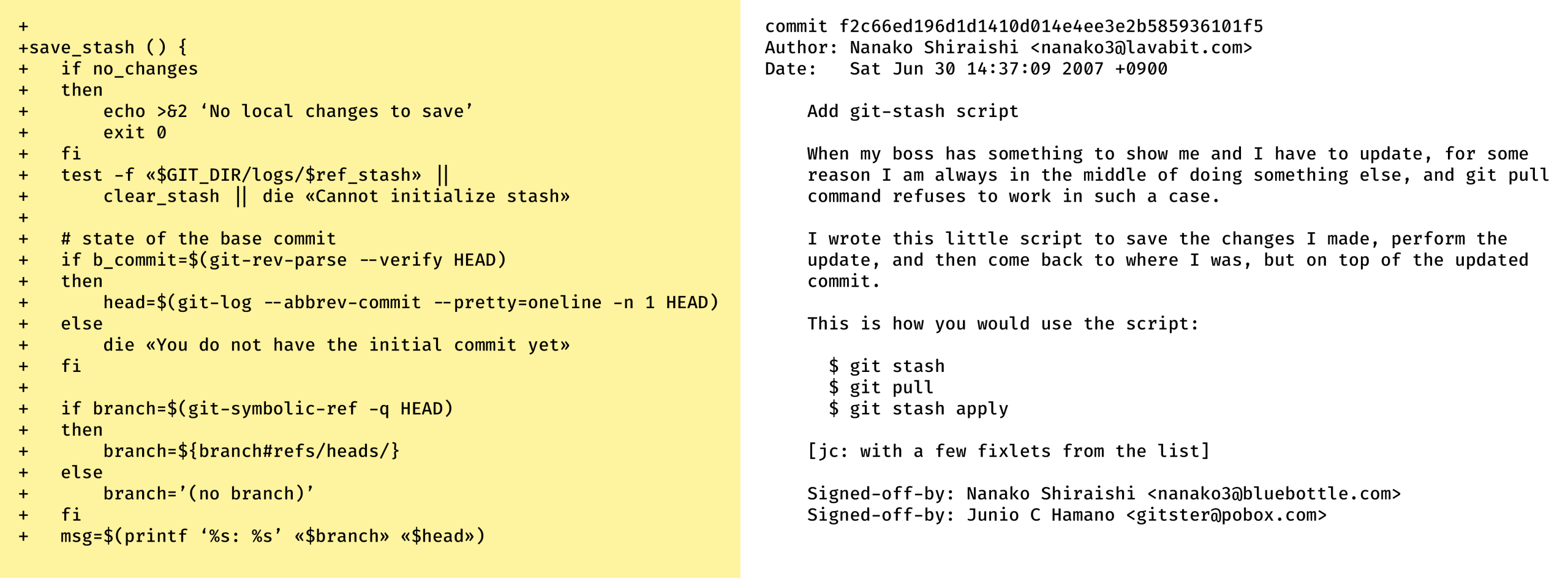
On the left are lines 24 to 48 of the original script written by Nanako Shiraishi; on the right is the commit message she left in June 2007, written in response to repeated interruptions from her boss. From that moment on, programmers who are interrupted during their work have been able to “freeze” their code, solve the external problem, and then return to their work without risking the loss of any changes. The stash command simply saves a temporary copy of the code being written without having to declare it as final (as in the git commit command) or before sharing it with others (as in the push command). The original stash script has long disappeared, yet commit f2c66ed19- 6d1d1410d014e4ee3e2b585936101f5 will always lead us right back to Shiraishi’s contribution.
We can learn so much from this commit: she’s one of the first women to contribute to the project; she likely lived in Japan; she cared enough about this script to contribute on a Saturday afternoon. We have the exact time and context of the action of writing the code, but we do not know anything else about the author, apart from the name and an e-mail address. We can’t go beyond that point: we are left with our questions and with the legacy of someone who was once interrupted by her boss. This fragment reminds us that source code is immaterial but not abstract. It is also an example of how programmers write programs not only to solve others’ problems, but also to improve the quality of their own lives; by sharing their work as free software, they help millions of other programmers in the same condition.
Git environment
Git is an open-source tool that helps programmers track changes in their code and work together without overwriting each other’s work. A commit is a snapshot of the project at a specific moment. It records what changed, who changed it, and why. By moving from one commit to another, programmers can explore the entire history of a project, recover previous versions, or understand how and why a piece of code evolved.
BIOGRAPHY
Gabriel Alcaras is a sociologist and postdoctoral researcher at Sciences Po’s médialab, in Paris. His work explores how everyday work practices, social norms, and invisible forms of labor shape software infrastructures. His research often begins with small digital traces, such as commits, scripts, or logs. He spends a lot of time trying to fill the gaps left in the archives of software development.
#Collaborative
#Free Software
#Git

