
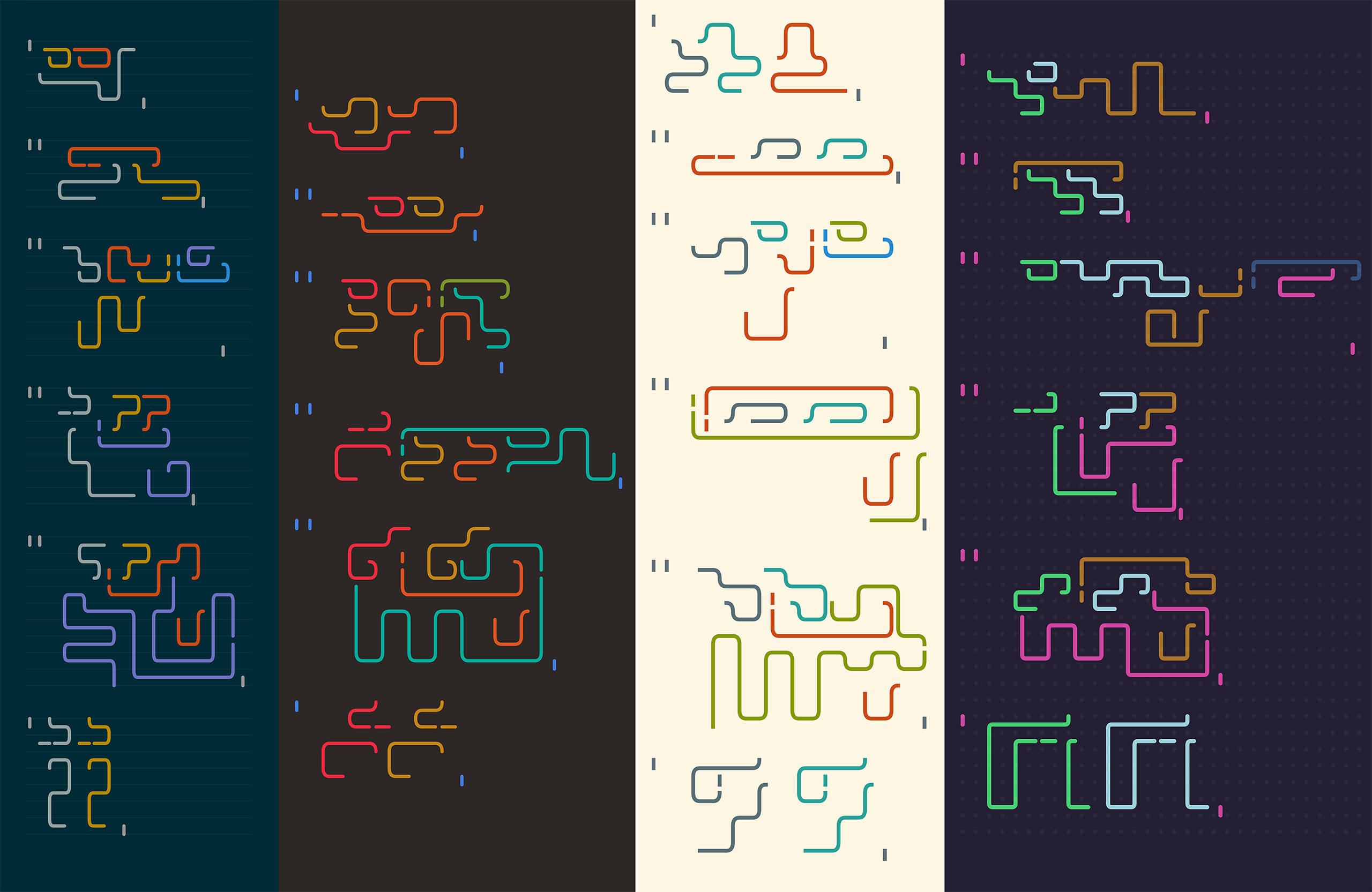
Daniel Temkin, Snippet of Rivulet code, 2025 [CC BY 4.0].
A programming language is also an invitation for others to interpret and experiment. Rivulet briefly became popular on the Hacker News online forum, where users were both fascinated and confused by it – one calling it “the most alien language specification I’ve ever read”. Others created their own programs and styles. Jo Wood, a London professor, even wrote a tutorial and built an editor to draw more cohesive and detailed glyphs.
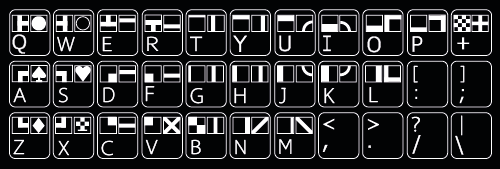
Closeup image of the keyboard for a Commodore 64 PC, showing additional box-drawing characters on the front side of each key [CC-SA 2.0, Wikimedia Commons].
ABOUT CODE
Programming is often seen as a serious, tedious task – but it can also be a playful, imaginative craft that explores alternate ways of thinking and digital realities.
Rivulet is a programming language shaped by calligraphy, maze-drawing, and the imagined alphabets of science fiction. Instead of using normal text, its code uses box-drawing characters – symbols once common on old computers like the Commodore 64. It explores what programming might look like if computers had developed through a different visual and logical tradition.
Programs are composed of flowing lines called Strands, which join together into Glyphs. Each type of strand has its own style and reading rules. Some strands represent constant values and flow left or right; others point to memory locations and are read only at their ends. This system lets programmers weave strands together into compact, visually complex patterns.
The four example programs shown all calculate the Fibonacci sequence. Though functionally identical, each takes its own visual path. Each time, the first glyph sets up the starting numbers, and the second repeats a loop that adds two values. Rivulet doesn’t use a normal “if” statement. Instead, it uses long Question Strands to test a result and undo the last group of steps if it fails, thus reversing rather than blocking actions.
BIOGRAPHY
Daniel Temkin creates photographic and computational art exploring logic and human irrationality. He is the author of Forty- Four Esolangs: The Art of Esoteric Code (MIT Press, 2025), the first artist’s monograph on programming languages. His blog esoteric.codes, launched in 2011, has been exhibited at ZKM, supported by ArtsWriters.org, and hosted at New Museum’s NEW INC, the first museum-led cultural incubator. Temkin has written for Hyperallergic, Leonardo, and Digital Humanities Quarterly.
#Esoteric Code
#Programming Language

