
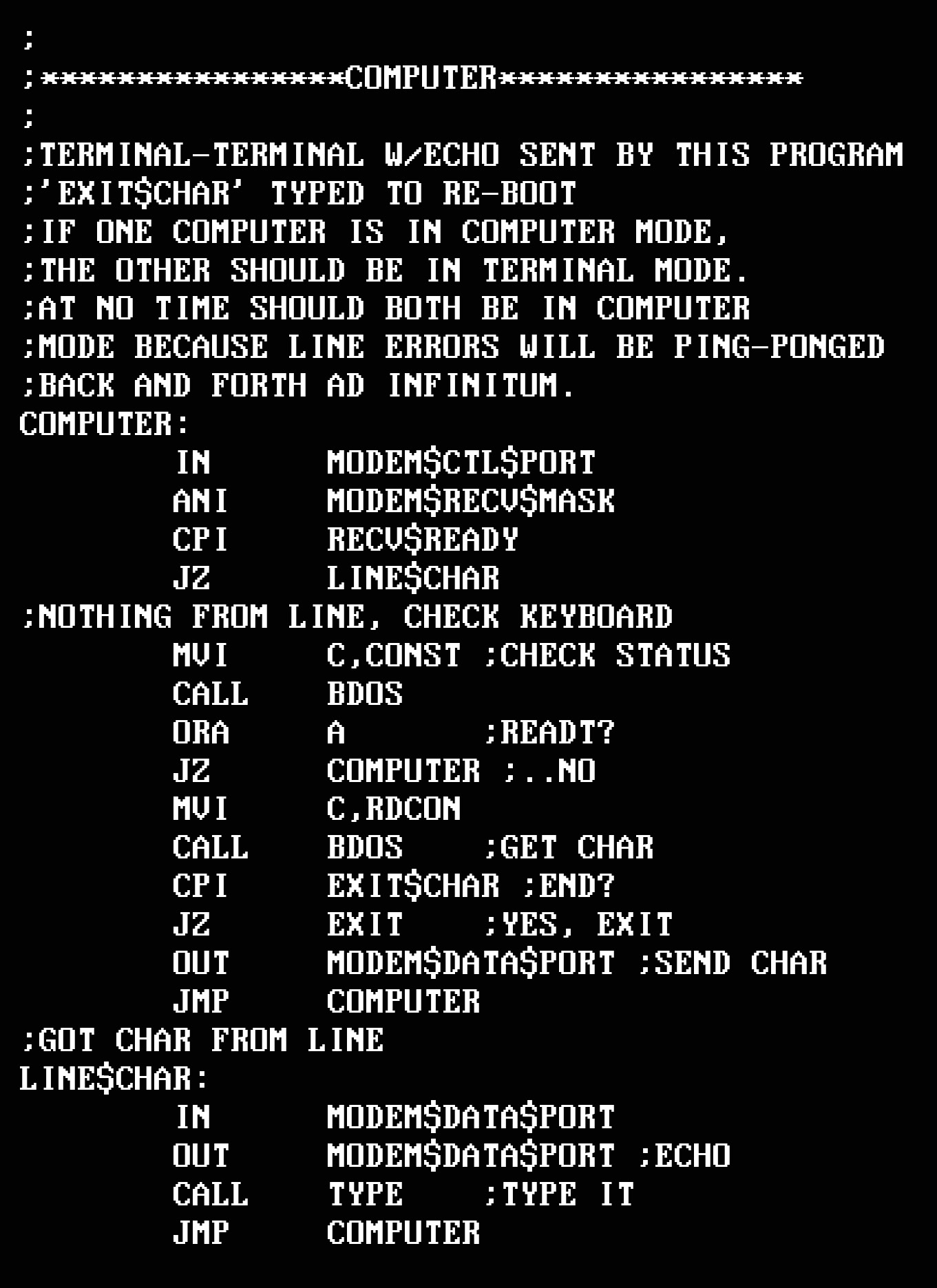
Snippet of MODEM.ASM
1977 [Public domain].
Ward Christensen passed away in 2024. The modems and phone lines that his software once lit up are now relics of a cyberspace gone by – but XMODEM lives on. From microcontrollers to datacenters, the “quick hack” he built for friends remains the Internet’s fallback mechanism, the protocol of last resort.
ABOUT CODE
In an era when data transfer protocols underpin everything from streaming video to cloud computing, it is easy to forget that the foundations of online communication were laid by hobbyists experimenting with primitive modems and phone lines.
XMODEM was one of their key invention – a protocol for transferring data between computers over acoustic-coupler modems and noisy telephone lines. Created in 1977 by Chicago hobbyist Ward Christensen and shared freely with his computer club, XMODEM soon became the de facto standard for swapping digital filesamong home computer users. In under 1,000 lines of assembly code, it divided a stream of data into 128-byte chunks, transmitted each “block” along with a numeric “checksum” to test for errors, and automatically re-sent any corruptedblocks. This clever procedure enabled faster and more reliable digital communications, giving rise to global networks of exchange.
The success of XMODEM owed as much to Christensen’s community spirit as its technical merits. His code was clearly written, wittily annotated, and explicitly invited modification – an ethos that encouraged collaboration and interoperability rather than commercial control. By the mid-1980s, many early online communities and services – such as RBBS and CompuServe – were using XMODEM to transfer files. It was an essential piece of infrastructure for grassroots computer networks like FidoNet, shuttling email and files among tens of thousands of online communities during the 1980s and 1990s.
acoustic-coupler
An acoustic-coupler modem was a device that sent computer data over regular telephones by “talking” in beeps and tones through the handset – a clever workaround for a world before digital phone lines or broadband connections.
BIOGRAPHY
Kevin Driscoll is the author of The Modem World: A Prehistory of Social Media (Yale University Press, 2022), co-author of Minitel: Welcome to the Internet (The MIT Press, 2017), and maintainer of the Minitel Research Lab, USA with Julien Mailland. He grew up lurking on local bulletin board systems and downloading files via XMODEM. He is an associate professor of media studies at the University of Virginia.
#Computer Networks
#Pre-Internet
#Community

